
Google Built-in
Launched Google built-in across Nissan and INFINITI with a North America go-to-market plan that turned complex setup into habit-forming adoption and measurable customer value.
INDUSTRY INSIGHT
With dozens of new models entering the U.S. market each year, automakers faced a clear mandate: integrate technology in a way that feels effortless, familiar, and safe. Drivers weren’t asking for “more features” as much as they were asking for less friction. The winners would be the brands that made advanced capability feel simple the first time someone sat behind the wheel.


INDUSTRY HISTORY
In-car tech began with radios and cassette decks, then progressed to CD changers, early navigation, and eventually full infotainment systems with touchscreens.
As features exploded, each manufacturer built its own menus and logic, creating a fragmented learning curve from one brand to the next. Apple CarPlay and Android Auto simplified this by standardizing the most-used experiences around the customer’s phone: music, maps, calls, and messages through voice and the center display.
Those platforms just projected the customers phone through the cars infotainment system. But those platforms couldn’t fully control vehicle functions. That next frontier was embedded platforms like Google built-in. And my job was launching Google built-in for Nissan North American!
MY ROLE
I led the Go-To-Market Plan for Google built-in across both Nissan and INFINITI, starting with the 2024 Nissan Rogue, 2025 Murano, and finally 2025 INFINITI QX80. Our teams worked to define the target audience, value proposition, promotion, pricing and trial structure, customer experience, and KPIs, while managing budgets, agency resources, and timelines across the U.S., Canada, and Mexico.


THE CHALLENGE
BARRIER #1: “The Set Up”
For security, Nissan built enhanced protocols to protect customer data. Unlike Apple CarPlay or Android Auto—where security lives on the phone—Google Built-in operates independently, requiring a more detailed initial setup. While this protected customer information, it also introduced friction at delivery. Once completed, daily use became as seamless as logging into your phone.
Fork in the Road: Do we rely on written instructions alone, or invest in step-by-step video to educate both sales consultants and customers? We chose video to reduce friction and increase setup completion.
.
The first launch was the 2024 Rogue, and we had less than six months to deliver a complete GTM plan. That meant building creative assets, writing copy, aligning channels, and coordinating across North America (U.S., Canada, Mexico) with no margin for rework.
Fork in the road: wait for “perfect” inputs, or build a fast, flexible plan that could evolve. We chose momentum.


BARRIER #3 “One Model, 2 Trims”
Google built-in was offered on 2 of 4 trims, limited to higher-priced upper trims. That created a risk: low awareness, inconsistent dealer explanations, and missed setup at delivery.
Fork in the road: Market it broadly and confuse buyers, or target precisely and train deeply. We chose precision. Education for sales teams became non-negotiable because setup success depended on confident, consistent guidance.
BARRIER #4 Subscription Plan
Like smartphones, data-enabled features require a carrier connection. The challenge wasn’t capability, it was perceived cost. Customers didn’t want “another subscription.”
Fork in the road: charge immediately and risk low adoption, or prove value first. We developed a trial experience so customers could explore Google built-in, build habits, and see the convenience before making a long-term decision.


EARLY INSIGHTS
With less than six months to launch, we moved fast. Google built-in was still new to the market, and awareness was limited even among industry watchers. Meanwhile, the competitive landscape was noisy: Nissan had “Hey Nissan,” Amazon was pushing Alexa integrations, and Apple CarPlay/Android Auto were becoming table stakes for many shoppers. We needed a strategy that created clarity and excitement quickly. One data point shaped the urgency: 37% of customers said Apple CarPlay and/or Android Auto was a must-have when buying a vehicle.
DEEP INSIGHTS
Customers loved convenience, but resisted recurring fees. If we wanted adoption, we had to reduce perceived risk.
Value Proposition: Google built-in as “more tech,” with “less hassle.” We integrated voice, maps, and a safer, more seamless drive experience, then paired it with a no-cost trial period so customers could experience the benefit before deciding.


WORKING BACKWARDS FROM PERFECT
We began with the end in mind: what would “ideal” look like from awareness to setup to habit formation? Using sticky notes, we mapped the journey step-by-step, then engineered the plan backwards to identify the moments that would make or break adoption.
PAINTING A PICTURE OF SUCCESS
Success meant full setup completion and at least two features used within 90 days. Our target: 75% of eligible vehicles.
GETTING ORGANIZED
I built a master business plan with an executive summary, mission statement, and a marketing calendar using swim lanes: milestones, owners, and drop-dead dates. Then I called the team together, walked through the plan, and invited feedback.
Collaboration moment: Then team defined where the data would coming from and trigger points. Discussed key dependencies to ensure timely delivery. Everyone left knowing their lane, their deliverables, and the timeline.


THE FRAMEWORK
Our objective was simple: customers who purchased a vehicle with Google built-in must (1) know it exists, (2) complete setup, and (3) use it within 90 days. We defined the channel mix to support each step: Email, SMS, IAM (in-app messaging) and IVM (in-vehicle messaging)
Fork in the road: spread across too many channels early, or sequence intentionally. We sequenced for clarity.
CREATIVE EXECUTION
COMMUNICATION
Once the framework was set, we built copy that earned attention and reduced friction.
Collaboration moment: we worked directly with Google’s marketing team to align on best practices, positioning, and feature education.
Fork in the road: long, detailed explanations or short, confidence-building prompts. We kept copy short and sharp with links to short videos and our website for deeper education


VIDEO PRODUCTION
In most cases, we would have agency people that could write scripts, but we were running mean and lean. I went to work with my team to create a dozen short form videos and one long form video. Now, we needed to be efficient with our resources, and we planned two to three shoots, so we could glean the dozen or so short form videos that we desired. These shoots would be full production, in studio or on location with actors, wardrobe, hair, and make up. During the shoot, we were not bystanders, we rolled up our sleeves and went to work behind the camera.
SHORT-FORM VIDEO > LESS THAN 1 MINUTE
I knew to be successful, we needed to shorten our copy and use video to deliver the visual that was needed. Buyers were already used to short form, it was natural to include them in our communications. This was super important with awareness of what Google built-in was and how it improved customer experience while driving. It was also important for engagement, if a customer wanted to know how a particular feature worked, we had a short video that would explain that.
LONG-FORM VIDEO < 3 MINUTES OR LONGER
We created longer video for sales consultants to support delivery and setup. The goal was consistency: if a consultant followed the delivery tool workflow (NCAR/ICAR), setup could be completed on the spot. There were incentives for sales consultants and dealers to ensure success by using the delivery tool.
Fork in the road: keep long-form internal only, or publish as a safety net. We added it to a YouTube playlist so customers could still self-serve if they slipped through the cracks.

WEBSITE RE-DESIGN
Customers struggled to understand which connected services were included by model/trim and which required a subscription or had a trial period. My team and I redesigned the site to be simpler and more intuitive, let customers see a comparison of features and trial lengths.
BUILDING AWARENESS AND ENGAGEMENT
Email was the heartbeat of our journey: awareness, engagement, conversion. Our job was to identify early whether a customer completed setup, then deliver the next best message based on their status.
We mapped the customer journey end-to-end and built decision-tree logic inside our CRM. If setup was complete, the customer received a welcome message and feature prompts. If not, the journey triggered targeted setup support.
Collaboration moment: marketing, product, and data teams aligned on definitions, timing, and event signals so the logic matched real-world behavior.


CRM ENGAGEMENT
Once set up, we moved from education to habit-building. We introduced popular features first (Google Maps, Google Assistant), pairing each with a clear benefit and a simple “try it now” prompt.
Fork in the road: blast the full list of features, or personalize and sequence. We sequenced and suppressed messages for features already used, so customers didn’t feel spammed and the journey stayed relevant.
IN-APP MESSAGING (IAM)
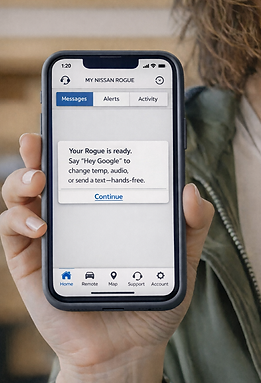
We added a new lever: in-app messaging. Customers needed the MyNissan or MyINFINITI app for connected services like remote start, lock/unlock, and alerts. That gave us a direct channel beyond inbox clutter. If setup wasn’t completed, we pushed an IAM within 30 days of delivery to re-engage customers in the environment they already used to manage their vehicle.

IN VEHICLE MESSAGING (IVM)
IVM was emerging: the ability to message customers directly through the infotainment system. Early tests showed promise but also highlighted limitations that needed improvement for maximum engagement.
Fork in the road: wait until it was perfect, or learn and iterate. We tested responsibly and kept it in our roadmap because the upside was huge: low cost to develop and deliver, with high contextual relevance.
THE EXECUTION
We ran weekly Nissan/INFINITI stakeholder meetings with global, as well as regional teams which included Canada and Mexico. This included: Product planning, Vehicle line marketing, Sales operations, Training, Infotainment engineering as well as suppliers Google, and SXM telematics support. We reviewed the timeline, flagged risks early, and solved problems in the room.
Collaboration moment: when issues surfaced, we assigned a single owner, defined next steps, and required a report-back so momentum never stalled and accountability stayed clear.


THE LANUCH
All three vehicles were launched on time: 2024 Nissan Rogue, 2025 Murano, and 2025 INFINITI QX80. We exceeded our goal, reaching 82% setup completion with two features used within 90 days.
Finishing well isn’t about speed—it’s about faithfulness: steady steps, a fixed focus, and crossing the line with nothing left undone.
WHAT I'D DO AGAIN / IMPROVE
After the 2024 Rogue launch, we held a retrospective and applied improvements to the 2025 INFINITI QX80 plan. Because INFINITI is a luxury brand, the team added a concierge service to proactively contact customers and guide Google built-in setup after purchase. I highly recommend this approach. It adds personalization, reduces friction, and protects the premium experience while increasing adoption.
